
Searching Decatur County Criminal Dockets
Decatur County trial courts offer no official public web form for criminal dockets. Go straight to Circuit and General Sessions Clerk Kelly Harden. Call 731-852-3125 or write PO Box 488, Decaturville, TN 38329. The state directory lists the court at 22 West Main Street. Confirm the right counter and access method before you drive over. Ask what the office offers. That may be public inspection, a terminal, a printout, copies by mail, or some other delivery option.
A name helps the clerk narrow a request. A case number works better. You may find it on a citation, indictment, notice, bond paper, or order. Offer a date range too. Say which court it is, General Sessions, Circuit/Criminal, city, or federal, if you know. Skip the extra private data.
- Find the docket number and the name of the court on the newest case paper.
- Contact the correct clerk and ask for the public docket or register of actions.
- Confirm the next setting, including any reset or continuance entered later.
- Read the charge, plea, disposition, and judgment as separate events.
- Ask whether a needed order is public and whether a plain or certified copy is required.
Decatur County Criminal Docket Clerk Route
Both Circuit and General Sessions records in Decatur County land on Kelly Harden's desk. The County Clerk is a separate office and does not hold criminal docket material. That split trips people up. A request mailed to the wrong county office wastes days and still finds nothing. For a second check on court roles and contacts, the Tennessee court clerk directory works well.
The official General Sessions judge profile names Paul Allen England as the Decatur County General Sessions judge. Use it to confirm the local court route, not as a docket search.
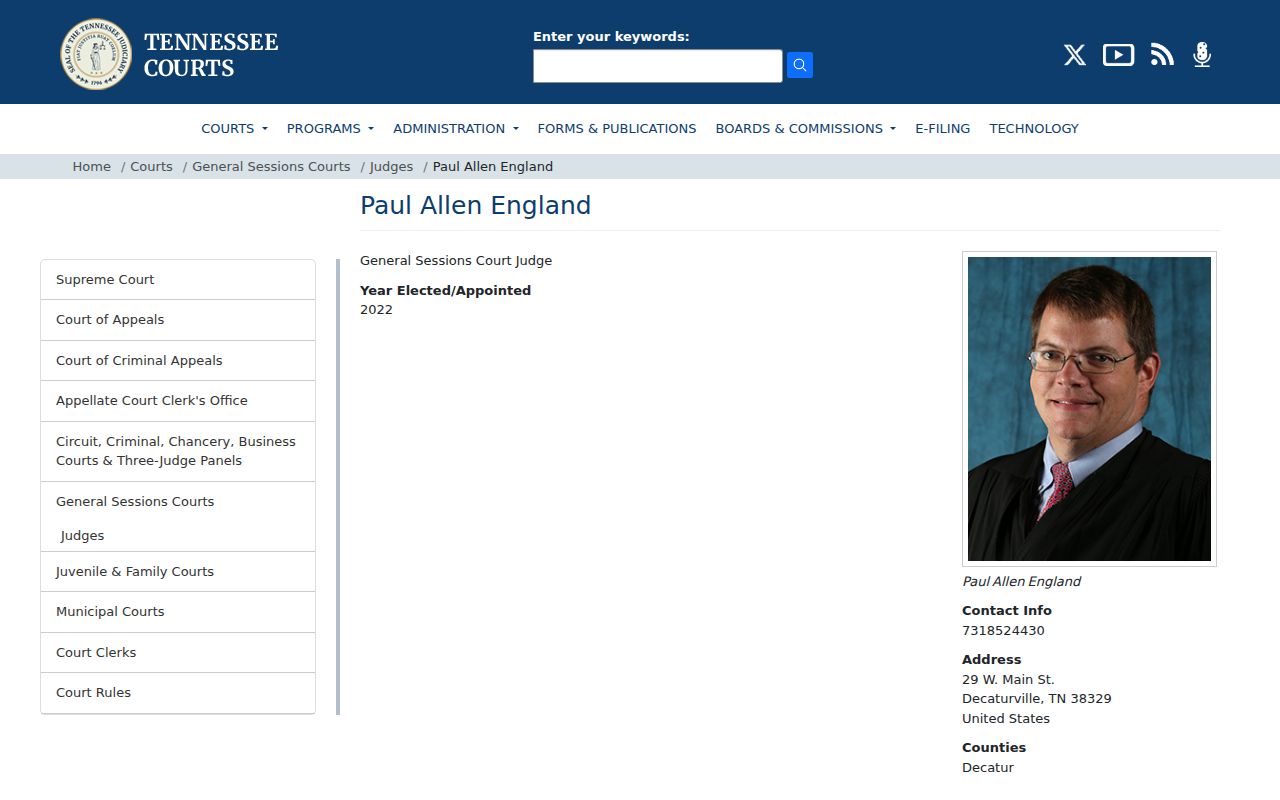
Let the judge listing verify the court. Then take the case docket, hearing status, or copy request to the clerk. A judge directory will not show a defendant's live case entries.
Circuit and General Sessions Clerk
Kelly Harden
PO Box 488
Decaturville, TN 38329
731-852-3125
Inside a Decatur County Criminal Docket
Think of a criminal docket as a dated court record. Ask the clerk for the case number, filing date, court and division, judge, case style, charge, cited statute or class, bond status, attorneys, event text, settings, plea, judgment, disposition, costs, probation entries, any related appeal, and restriction markers. Decatur County publishes no field-by-field public schema. The exact labels and number pattern have to be confirmed with the clerk. A sample number format from elsewhere may not apply locally.
| Case number | The court-assigned identifier. Quote the exact docket number shown on the case paper. |
|---|---|
| Charge | The alleged offense and, when recorded, its statute or classification. It is not a finding of guilt. |
| Setting | A scheduled arraignment, pretrial event, motion hearing, trial, or later reset. |
| Plea | The plea entered in court. It is distinct from both the charge and final judgment. |
| Disposition | The recorded result, such as a plea, dismissal, diversion, trial result, or transfer. |
| Restriction | A marker that may limit access because of sealing, expungement, confidentiality, or another rule. |
Ask which event lines link to public documents. An entry can be visible even when the filing behind it is restricted or unavailable online.
Courts That Hold Criminal Dockets
General Sessions handles limited criminal work. It includes early felony proceedings and the misdemeanor matters Tennessee law allows. Felony trial-level cases run through the Circuit/Criminal court. Its Decatur County judges are J. Brent Bradberry and Bruce I. Griffey. A city ordinance or municipal traffic matter may sit with the Decaturville, Parsons, or Scotts Hill city clerk instead.
| Court route | Typical role | Record contact |
|---|---|---|
| General Sessions | Limited criminal jurisdiction and preliminary proceedings | Kelly Harden |
| Circuit/Criminal | Felony trial-level and court-of-record matters | Kelly Harden |
| City court | Municipal ordinance or traffic matters | Relevant city clerk |
| Federal court | Federal charges in the Western District | Federal clerk and PACER |
Statewide tools get misread too. Tennessee Public Case History covers appellate cases, not a countywide criminal trial search. TennesseeCaseFinder may offer Circuit or General Sessions inquiry, though Decatur participation is unclear.
Note: Identify the court before asking for records. The same name can appear in unrelated systems.
How a Criminal Case Moves
Read a docket as a sequence. An accusation opens the matter. An indictment is a later charging act. A setting puts an event on the calendar, and a plea records the defendant's response. The disposition states how the matter ended at that stage, while a judgment or sentencing entry captures the court's formal action. A reset only moves the date. It does not erase the case.
Docket flow: Filing → Arraignment → Pretrial → Plea or Trial → Disposition → Sentencing
Later lines may show an appeal, a probation violation, or an expungement petition. Always confirm the newest line and its date. An old setting can stay in the history long after the hearing moved.
Decatur County Criminal Docket Filing Mix
For dated context, the AOC filings and dispositions report covers fiscal year 2024-25. It counts 159 Decatur criminal filings across its categories. Probation violations led at 41. Drugs followed with 25. Other public-welfare offenses drew 20, and burglary or theft added 19. These are aggregate filing counts, not people, unique cases, or a current pending docket. They prove nothing about any named person.
The report also lists 169 dispositions. Manner totals include 86 guilty pleas as charged, 48 dismissal or nolle prosequi entries, 14 convictions after trial, and 13 pretrial or judicial diversions. A statistical bucket never tells you the facts or result of one case. For that, pull the case's own docket and signed order.
Sealed Dockets and Public Access
Tennessee treats its court records as public by default. Tennessee Supreme Court Rule 34 spells out the exceptions. It covers case, administrative, and judicial records alike. Inspection is allowed unless a statute, another rule, or a sealing order says otherwise. Juvenile matters, protected filings, unpublished drafts, internal deliberations, judge copies, and case-management material often sit outside what the clerk can release.
Keep your request tight. Give the court, the docket number, and the date range. Say whether you want to inspect, get a plain copy, or get a certified copy. Ask for a cost estimate up front. Decatur County posts no criminal copy fee schedule, so the clerk will set the price.
Key access rules:
Rule 34 presumes access to court records but preserves legal and court-ordered exceptions.
Tennessee Public Records Act guidance explains inspection and copy-request principles for Tennessee citizens.
Sealed, juvenile, confidential, and expunged material requires a different access expectation.
Read Decatur County Criminal Docket Results
A disposition label means little without its event date and the court order behind it. The TJIS criminal reporting manual from Tennessee's court system lays out how clerks statewide code criminal case information. Use it as a decoder. The local Decatur County docket still controls.
Statewide reporting terms get you only so far. The real case facts live in the Decatur County clerk's register and the orders on file there.
- Nolle prosequi
- A prosecution decision not to proceed with a charge at that time. Read the actual order and related counts.
- Continuance
- A court-approved move to a later date. It is not a dismissal.
- Disposition
- The recorded outcome at a case stage or for a charge.
- Diversion
- A statutory route that may defer a final conviction under set terms. Eligibility and effect depend on the order.
Decatur County Criminal Docket Expungement Route
Expungement starts in the court that heard the case. You will need the docket number. The Tennessee courts expungement resource lists the qualifying categories. Those include dismissal, acquittal, no true bill, release without charge, and nolle prosequi. It also walks through certified orders, charging papers, and mailing requirements. Confirm eligibility and current cost with the originating clerk and the Tennessee Bureau of Investigation.
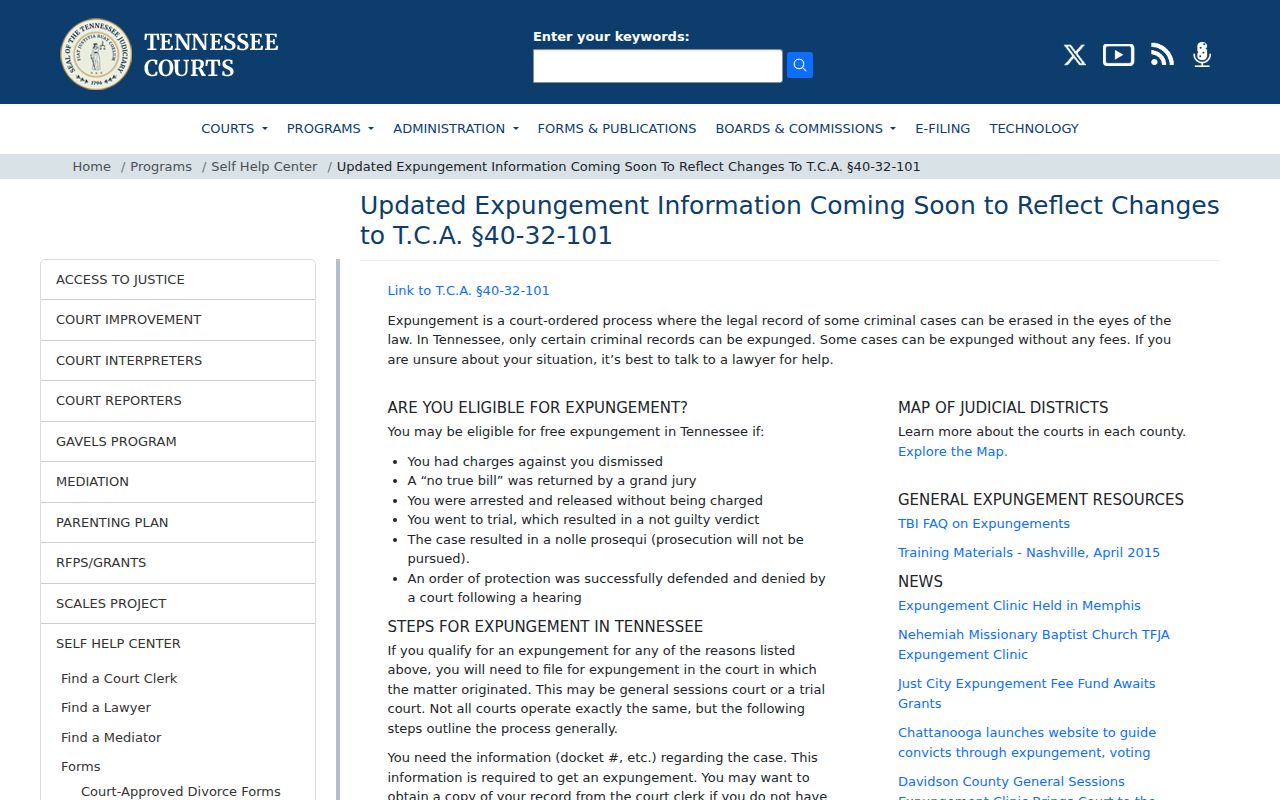
Expungement does more than hide a search result. The state process can delete eligible charge data and send the order to the agencies that hold it. So a blank docket entry proves nothing about what was once there.
Decatur County Criminal Docket Verification
Before trusting a docket entry, set it beside the filed judgment or order. A payment portal receipt only proves payment. A jail or arrest source shows custody or an accusation, never the court's final result. An appellate search covers a later review, not every trial event.
When a Decatur County entry looks wrong, call the clerk and quote the case number. Do the same if a criminal docket lags. Ask whether a newer order, a reset, an appeal, a restriction, or a related case now controls. City matters belong with the issuing city clerk. Federal criminal cases go through the Western District of Tennessee clerk and PACER. PACER has its own account, fee, redaction, and sealing rules.
Note: Confirm the latest court date directly with the clerk before appearing.